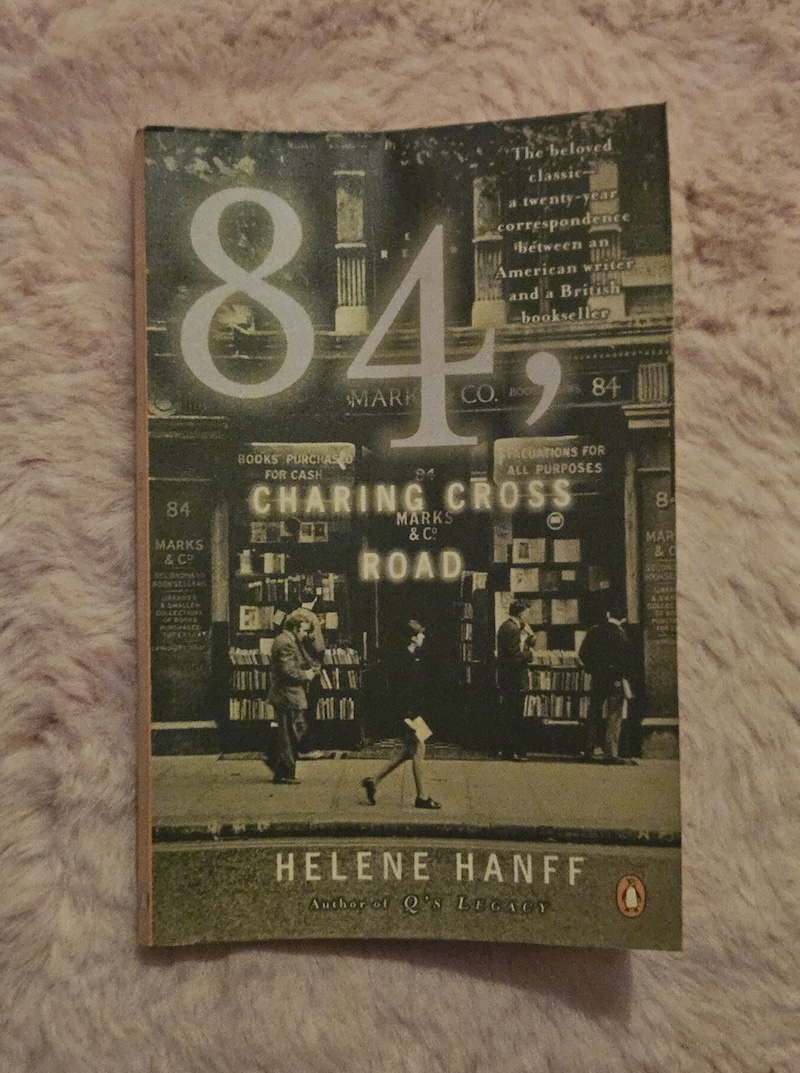
Author: Helene Hanff
Book Edition/Publisher: Penguin Books
Year Published: 1970
Number of Pages: 95
I was home resting and recovering from an episode of sinusitis, and I looked for something to occupy myself with that didn’t require a lot of energy. I knew my attention span was shot, so I decided to read something light and went to see if my bookshelves offered anything intriguing. The vertiginous black dot motif on the cover of Sartre’s Nausea stared back at me almost hypnotically, as if trying to will me into picking it. Yeah nah, that’s not something I can handle today.
I pulled Helene Hanff’s 84, Charing Cross Road from the back row of books. It was a compilation of letters exchanged between the author, a writer and ardent bibliophile based in New York, and various staff members of a secondhand bookshop (Marks & Co.) located at the eponymous Charing Cross Road in central London. Helene has a fondness for beautifully-bound, rare volumes which the shop specialises in stocking secondhand, and she and the shop staff develop a sweet transatlantic friendship over the course of their business transactions. Apparently, this exchange spanned over a period of 20 years. It seemed hard to believe, but I looked at the dates on the first and last letters in this book: October 1949 and October 1969. Huh, they were right.
I got this book way back then from Book Depository, during my uni years. I feel a sad pang knowing BookDepo is now defunct, which feels like a parallel of some sort to the closure of the secondhand bookshop in 1970, which I also just realised doubles as the book’s year of publication.
Helene’s charm and wit immediately shine through from the first few pages, and they still tickle me no matter how many times I’ve read her writing. When the bookstore wasn’t able to get the books she wanted, she wrote, “you leave me sitting here writing long margin notes in library books that don’t belong to me, some day they’ll find out i did it and take my library card away”. And, I can tell you, it’s refreshing to read actual and proper writing again. It’s like a breath of fresh air in a world of AI-regurgitated nonsense. Someone uses the word “oughtn’t” in their letter on page 20. It made me feel like I was a schoolgirl reading an Enid Blyton book after school again.
Their friendship blossomed quickly; Helene gifted the staff packaged consumables from America after being told of about their post-WWII food rationing scheme. She candidly tells Frank about her upstairs neighbour’s boyfriend’s lawsuit with the postal service. The other staff start personally writing, one by one, to Helene, thanking her for her generosity. One of the staff gave Helene detailed advice on making a Yorkshire pudding, when asked. They invited her on several counts to come to England to visit them at the bookshop, but saving up for the trip was no easy feat. There was a point where it seemed she would make it there soon after all, but then she had to have all her teeth capped at the dentist’s, which seems to have to sent her back to square one, financially. Another time, she was set back yet again because she signed a new lease and had to buy furniture for her new home.
It’s evident that Ms Hanff was much-loved by her friends at Marks & Co. Frank, her primary correspondent, is often seen going the extra mile to hunt down and procure the rare titles in the editions she asks for. They often eagerly offer to gift her things in return, and she is assured that should she ever drop by in London one day, there would be a bed and place for her for as long as she wished to stay.
It feels strange to read about historical events mentioned so casually in this book and in future tense, like Queen Elizabeth II’s accession (in Helene’s words: “…so Elizabeth will have to ascend the throne without me, teeth are all I’m going to see crowned for the next couple of years.” This girl is hilarious) and support for Churchill in the then-upcoming general election.
I found this book touching in several ways, the main one being Frank’s British reticence dropping gradually over the course of their letter writing. Toward the end of the book, he wrote to Helene (of her recent professional developments in the television industry as a writer):
“We are all sorry to hear that your television shows have moved to Hollywood and that one more summer will bring us every American tourist but the one we want to see.”
Aww, Frank. No, it’s really so touching compared to how reserved and formal he was in his very first letter to Helene.
It was a little sad to watch the gap between the letters grow wider in the last few years as the correspondents understandably went on with their busy, busy lives; the letters between pages 89 and 90 are three years apart.
Reading all about the shop staffs’ food struggles and seeing how grateful they were for basic food items like dried eggs and ham was pretty sobering.
At just under a hundred pages, the book on a whole is a slim volume and a quick read, but I still thought about it for a good while after finishing it. Overall I’d say it was like the reading equivalent of drinking a mug of hot chocolate on a cold night.