“What happens in the heart, simply happens.”
– Ted Hughes
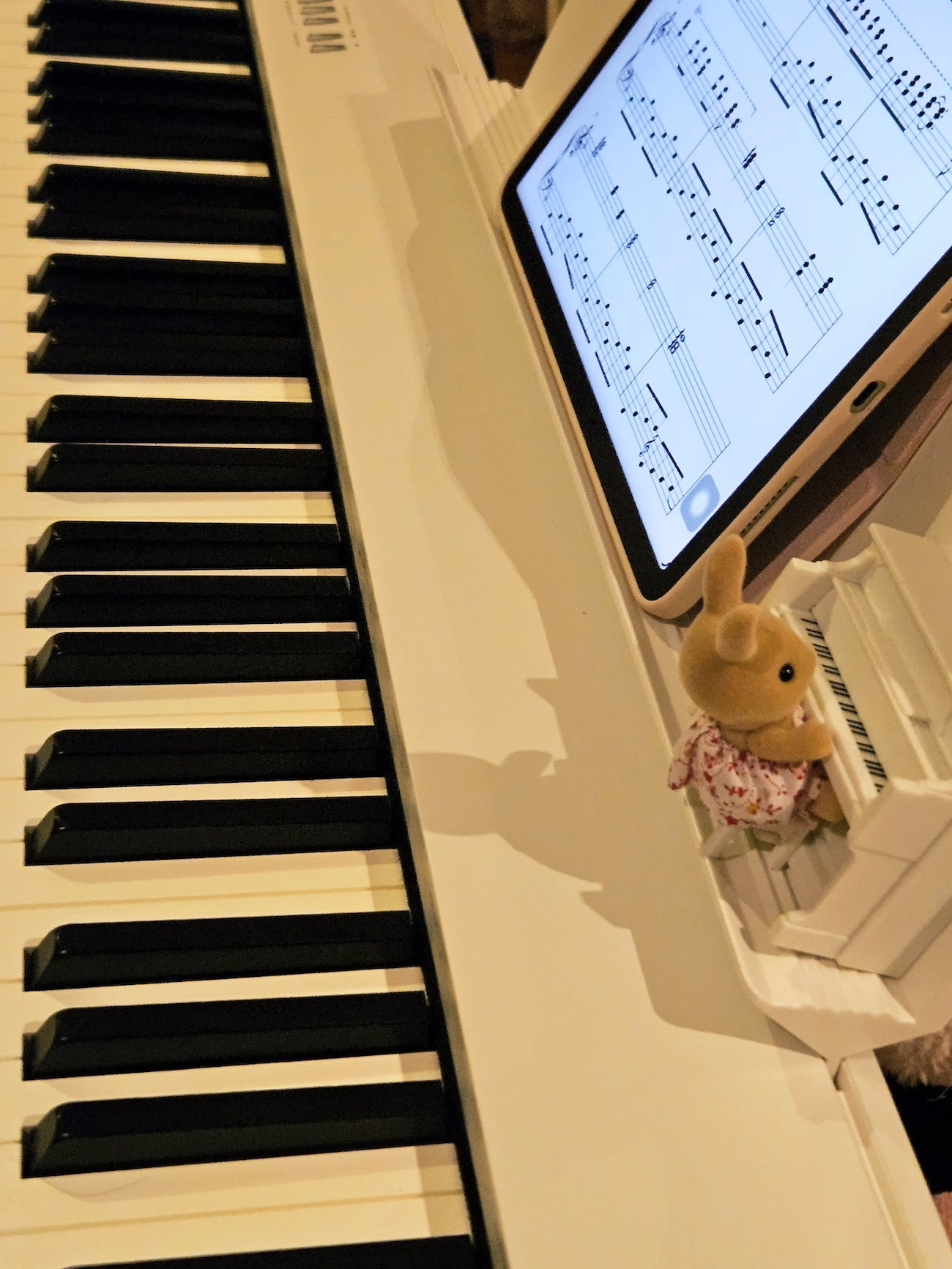
My favourite Chinese song of all time is Eason Chan’s Fu Shi Shan Xia (富士山 is Mt Fuji), which was released in 2006. I’m trying to learn to play it right now. It’s so pretty on the piano. I’ve finally albeit reluctantly removed my gel nails after having had them for almost 2 months, so I can play properly again. Every morning, I wake up around 8 am and sit down to work through a page or two before the first morning coffee. Violin practice is reserved for afternoons because I need an entire morning to brace myself. Playing a fretless instrument whose intonation is contingent on my fingers landing precisely to the nearest nanometer on the fingerboard is not a morning activity for me, nope.
Being a violinist first and foremost, the piano sheet is still a struggle for me. I also found the cello sheet music by accident, but I won’t try learning it just yet. My brain gets confused enough just switching between the violin treble clef and the piano grand staff, without throwing cello into the mix. I could be sitting down with my cello between my legs and I’d stare at the lone bass clef and it would still take a good five seconds to remember what instrument I’m supposed to be playing and things like, oh right, that note on the staff is a C, not an A.
Playing this on the violin feels like one long, uninterrupted flow state. Since I’m better at reading violin sheet music, it frees up enough of my cognitive bandwidth to let me really focus on enhancing the piece’s musicality through experimenting with different prosodic techniques. Sometimes I get carried away and play with excessive, uncalled-for levels of rubato and it just sounds like jazz. I have to rope myself back in when that happens. On the piano, my playing comes out choppy and strangled because all my mental resources are tied up in reading notes.
I wanted to learn this song because I needed an outlet and shape for some of the thoughts and feelings I had been having lately. I know those feelings will fade, but I need some form of expression in the meantime. This song resonated with me, since the crux of it was that, as explained by the song’s lyricist Lin Xi: liking someone was like admiring Mt. Fuji; you could not claim it for yourself or take it away, you can only visit and experience it, and that had to be enough.
「其實,你喜歡一個人,就像喜歡富士山。你可以看到它,但是不能搬走它。你有什麼方法可以移動一座富士山?答案是,只能你自己走過去。愛情也如此,逛過已足。」
– 林夕
Each note I play is a building block for a bridge over a river I don’t otherwise have the tools otherwise for, to cross.「誰都只得那雙手/ 靠擁抱亦難任你擁有」: we only have these two hands, and we can’t keep something just by refusing to let go.
There’s actually also a Mandarin version of the song titled《爱情转移》. I personally think the Cantonese one hits harder, despite not being able to appreciate its semantic nuances natively. In the Mandarin lyrics, personal pronouns are used minimally. There is emotional distance between the listener and the song. It explores the vicissitudes of love through a normative lens. Something remains at the end of all of it, sometimes people get that happy ending together despite everything. Don’t be the scapegoat of love, it seems to say; love exists somewhere but don’t lose yourself when you find it. It ends on a note about not being disappointed, hinting that the best is yet to come.
The Cantonese lyrics on the other hand get a lot more personal and metaphor-heavy, and there’s a lot more of “you” and “I”. The narrator tells us intimate, specific details about the love interest in the song and their relationship. The music is centered around mutually ending the relationship so that both can be free. The only implied hope for a happy outcome hinges on the love interest starting over without the narrator, rather than finding a way to stay together, like what is suggested in the Mandarin version. The Cantonese version is about resignation, forgetting, and moving on. The narrator has decided this is the best outcome for everyone and is trying to convince his unwilling partner to accept the end of the relationship.
Listening to it while having coffee is an experience all on its own, because the caffeine amplifies the highs and lows of my emotions while listening. I guess I like breaking my own heart and then putting it back together because it always somehow changes me for the better. Steel is forged in fire, they say.
I visited my metaphorical Mount Fuji once last month, quite possibly for the last time, and who will never get to see me play this or know what they are to me. And I think the knowledge of this impossibility of a next encounter bleeds into my musical phrasing as intensity, the way adding salt to boiling water slightly raises its temperature. For the record, I very much enjoy my solitude. I don’t find myself actively wishing for a partner. Daring to stay single in a world where being a single woman in her 30s is a double-whammy of societal prejudice and penalisation through ‘singles tax’ is one of the most honest decisions I have made for myself, and it has rewarded me with plenty of immaterial gifts.
That doesn’t mean I’m immune to having feelings, whatever they may be. I can’t not feel the emotional charge when someone takes the pen from my hand and writes out a page for me in between the many beautiful chapters I had written for myself in the book of my life. There is a curious cognitive dissonance running beneath the sadness that it could never blossom into anything more because of circumstances beyond either of our control, because things are the way they are; it is the knowledge I cherish being single because of the freedom it affords me to chase my other passions and have complete autonomy over my life’s trajectory.
When my feelings consume me, I don’t fight them. They blow through me and I know they will pass and I know sometimes I will be changed afterward. I have personally found no stronger catalyst for self-improvement than such an episode of intense feeling. It’s not ideal, but I make the most of it when it happens. I throw myself obsessively into a hobby or some other character-building undertaking to feel worthy of whoever I’ve put on a pedestal. When enough time has passed for me to see the situation clearly for what it is, the growth still remains. It’s a good kind of sad, being sad because something wonderful is over. But it had been mine, for a moment, even if I couldn’t take it. What I’m feeling is just another colour on the full spectrum of this human experience.
The line「短暂的总是浪漫 / 漫长总会不满」perfectly encapsulates how I feel about relationships and how I stay grounded in my solitude. A tryst with someone you’ll never see again is more romantic simply by virtue of its brevity, even if it is less ‘real’; because there is not enough time for the reality of incompatibility to set in; because there is romanticism in martyrdom: on the other hand, an enduring love more often than not gradates into dissatisfaction over time. Anything else appears to be an outlier, rather than the norm.
「一生一世等一天需要代價」: waiting your entire life to be together forever one day comes at a price; the price is the life you could have lived otherwise. 彼此終必火化 however things turn out, we don’t live forever on this earth, and we return to the same chess box. Decide wisely.
「人活到幾歲算短 / 失戀只有更短」 (Life is short, heartbreak even more so; it’s not the end of everything)
「為何為好事淚流?」 (Why cry over a good thing?)
Something isn’t diminished just because you can’t keep it. The visit is enough, it has to be enough, it is actually more than enough if you let it be.